Scope of Market Research: Why It Matters for Business Growth
Market research is the process of collecting, analyzing, and interpreting information about a market, customers, competitors, and industry trends. It helps businesses make informed decisions, reduce risks, and identify new opportunities for growth.
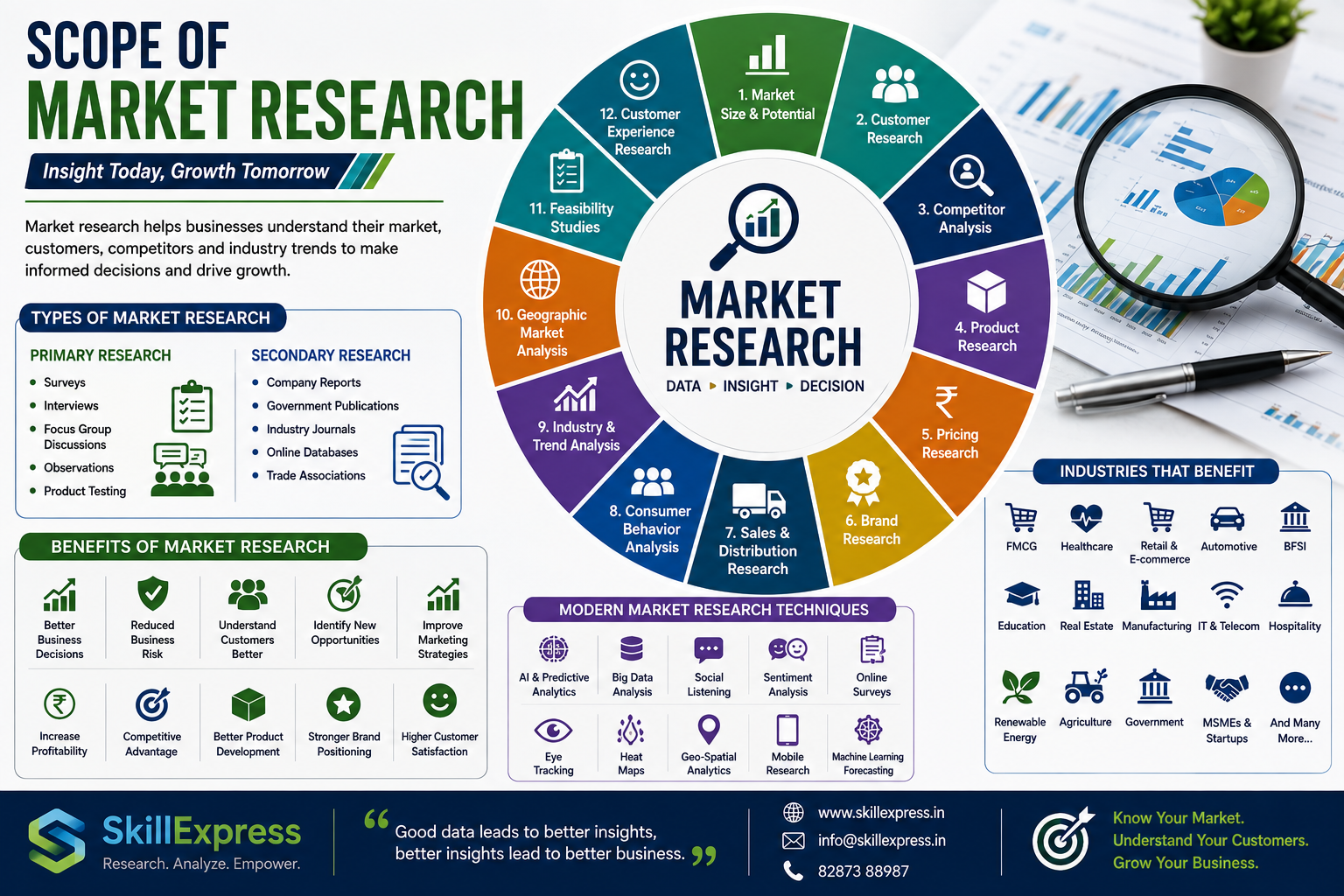
Scope of Market Research
1. Market Size and Potential
-
Estimate the total market size.
-
Analyze current demand and future growth potential.
-
Identify emerging markets and opportunities.
2. Customer Research
-
Understand customer needs and preferences.
-
Analyze buying behavior and decision-making patterns.
-
Measure customer satisfaction and loyalty.
-
Segment customers by demographics, geography, and lifestyle.
3. Competitor Analysis
-
Identify key competitors.
-
Evaluate competitors' strengths and weaknesses.
-
Compare pricing, products, and services.
-
Monitor competitor marketing strategies.
4. Product Research
-
Test new product ideas.
-
Evaluate product features and quality.
-
Analyze customer acceptance.
-
Conduct product usability studies.
5. Pricing Research
-
Determine optimal pricing strategies.
-
Assess customer willingness to pay.
-
Compare competitor pricing.
-
Analyze price sensitivity.
6. Brand Research
-
Measure brand awareness.
-
Evaluate brand perception.
-
Analyze customer trust and loyalty.
-
Study brand positioning.
7. Advertising and Promotion Research
-
Test advertising campaigns.
-
Measure campaign effectiveness.
-
Evaluate digital marketing performance.
-
Analyze return on marketing investment (ROMI).
8. Sales and Distribution Research
-
Identify effective sales channels.
-
Evaluate distributor performance.
-
Optimize supply chain strategies.
-
Study retail and online distribution networks.
9. Consumer Behavior Analysis
-
Study purchasing habits.
-
Understand motivations behind buying decisions.
-
Identify seasonal trends.
-
Predict future consumer behavior.
10. Industry and Trend Analysis
-
Monitor industry developments.
-
Analyze technological advancements.
-
Identify market trends.
-
Assess regulatory changes.
11. Geographic Market Analysis
-
Evaluate regional demand.
-
Identify expansion opportunities.
-
Compare urban and rural markets.
-
Assess international market potential.
12. Feasibility Studies
-
Evaluate the viability of new business ideas.
-
Conduct location analysis.
-
Assess investment opportunities.
-
Identify potential risks.
13. Customer Experience Research
-
Measure customer satisfaction.
-
Analyze service quality.
-
Identify areas for improvement.
-
Monitor customer feedback.
14. Digital Market Research
-
Website traffic analysis.
-
Social media sentiment analysis.
-
Online consumer behavior.
-
Search engine trend analysis.
15. Public Opinion Research
-
Government policy surveys.
-
Election and political research.
-
Social impact assessments.
-
Community perception studies.
Types of Market Research
Primary Research
-
Surveys
-
Face-to-face Interviews
-
Telephone Interviews
-
Online Questionnaires
-
Focus Group Discussions (FGDs)
-
Field Observations
-
Mystery Shopping
-
Product Testing
Secondary Research
-
Government Reports
-
Industry Publications
-
Census Data
-
Company Reports
-
Research Journals
-
Trade Associations
-
Online Databases
Industries That Require Market Research
-
FMCG
-
Healthcare & Pharmaceuticals
-
Retail & E-commerce
-
Automotive
-
Banking & Financial Services
-
Education & EdTech
-
Real Estate
-
Manufacturing
-
Information Technology
-
Telecom
-
Hospitality & Tourism
-
Renewable Energy
-
Agriculture
-
Government & Public Sector
-
MSMEs & Startups
Benefits of Market Research
-
Better business decisions
-
Reduced investment risk
-
Improved customer satisfaction
-
Increased profitability
-
Competitive advantage
-
Better product development
-
Effective marketing strategies
-
Stronger brand positioning
-
Higher customer retention
-
Faster market expansion
Modern Market Research Techniques
-
AI-driven Consumer Analytics
-
Big Data Analysis
-
Predictive Analytics
-
Social Listening
-
Sentiment Analysis
-
Geo-Spatial Analytics
-
Mobile Surveys
-
Eye Tracking
-
Heat Maps
-
Machine Learning-Based Forecasting